

In the context of migration, the burial site expresses both power of silence and the invisible. In the Sahara Desert, the corpses of deceased immigrants are visible. Yet, silence dominates the entire funeral process to offer the dead a funeral ceremony worthy of the name. When the tragedy of death occurs in the ocean, the invisible imposes itself as the dominant power. Nobody can see either the corpses of dead immigrants or the conditions under which they breathed their last. In this way, the invisible occupies the environment surrounding the tragic ends of immigrants, and silence prevails among their relatives and parents unable to mourn their dead. The impossibility of mourning in this regard can be situated in the absence of a burial site. A grave for the departed stands as the root that ties them to their late family.

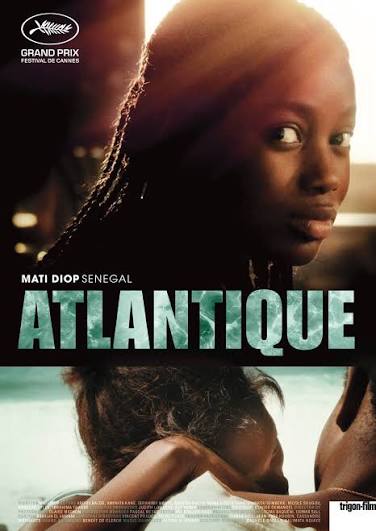
Atlantics Mati Diop
Atlantics offers an insightful look into immigration from the perspective of young migrants. Released in 2019, the movie opens with a futuristic vision shaped by the building of a great tower. The young men fed up with working without payment decide to take a stand. Mr. Ndiaye refuses to pay them their monthly salaries. From this disappointment rises their desire to migrate and leave Senegal for better living conditions. Unfortunately, all these young candidates for migration disappear in the ocean while trying to reach European borders.
In this tragic story there exists a love story between Ada and Souleiman. However, their love faces an obstacle: Ada is a bride-to-be for Omar, and she also must face the absence of Souleiman. All young people who went into the ocean become ghosts, take possession of the (ir) girls’ bodies, and reclaim their due from Mr. Ndiaye. However, our analysis revolves around the scene that occurs toward the end of the movie (from 1h 31min to 1h 34min).
The possessed bodies of the female actors face Mr. Ndiaye, who has no choice but to pay their due. After they count the money to check that the amount is correct, Mr. Ndiaye expresses his desire to go. Yet, one of the possessed girls refuses and lets him know that he is the cause of their tragic deaths. Mr. Ndiaye must dig the graves at the burial site for each of those young boys whose bodies do not have a grave that symbolizes a reminder of their existence. Therefore, what is the role that the burial site and the grave play in the context of the migration question?
❖ The burial site as space of memories and trauma appropriations:
In an interview held on Sept. 30, 2019, on France Culture, the journalist asked Mati Diop : “Quelle mémoire de ceux qui sont partis et jamais revenus ?”- (https://www.youtube.com/watch?si=s0f8TT17aJjhbTcc&v=HlIWthOK7SY&feature=youtu.be. Retrieved on August 27, 2026). “What memory is there of those who left and never returned?” In these words, the journalist sets the context to address the enigmatic question of migrants who lost their lives in the Atlantic Ocean. The presence of the ocean is so striking, and in the film, it is not a neutral site. It bears a memory back to the tragic ends of enslaved people during the Middle Passage. In this regard, the shots on the ocean also remind us of all those bodies without graves, unearthing the fact that they once existed. In the context of the film, the ocean connects the living actors with the young people who passed away while trying to reach European borders.
By staging this moment that gathers Mr. Ndiaye and the ghost boys who take possession of bodies of the girls, Atlantics provides a way to settle the context of memory appropriation. Indeed, the trauma behind not having graves for the dead finds its roots in the failure of family members to mourn their dead. There is no way of thinking of turning the page without knowing if the dead rest in peace. A grave is a way to find the strength both to mourn the deceased and to try to heal from the injury of that loss. A grave connects; it bears a memory, and its absence digs the hole of the traumatic conditions of the living people.
Atlantics (2019)
When the possessed women are counting the money Mr. Ndiaye brings to pay, they are sitting on a tombstone that has a name on it. This shows there is an urgency, after having paid them their due, to build such a memorial place can prevent their memories from fading into oblivion. The low-angle camera shot at Mr. Ndiaye shows the position of superiority he once had vis-à-vis his employees, who have now become ghosts.
This camera angle also helps to convey the arrogant attitude of Mr. Ndiaye. He thinks the simple fact of paying the money repairs the trauma born out of the tragic deaths of Souleiman and his colleagues. In this regard, when Mr. Ndiaye says in a trembling voice, “let me go. You have the money,” one of the ghost girls replies, “you are going nowhere. It is your fault we are dead. Never forget.” Mr. Ndiaye finally takes off his arrogant coat and says he is sorry. Yet all voices of the ghosts echo in a mocking tone to show him this money is not comparable to the fact that his refusal to pay them cost their lives. One of the possessed girl requests Mr. Ndiaye to: «dig our graves first.”
In this regard, the healing process requires digging the grave, for it is the only way to help their bodies confined in the ocean to come back. The grave replaces the absence, for without it, the missing of their dead bodies brings back the knife at the very injury that caused the trauma that the living bodies reenact. The close-up on the digging tool and the movements of the body of Mr. Ndiaye is meant to remind him of the precarious working conditions of his employees. The pain he feels at this moment brings to the surface a sort of justice which helps us to understand that every single worker needs recognition of the value of his work.
In a mocking voice, one of the possessed girls points out, “look, he does not know how to dig or to work.” This point does not mean settling scores but letting him know the pain that rests in the process of building his great tower. She even adds, “this is the real work.”
The movements of Mr. Ndiaye and the camera angles that shape his actions echo the pain of those whom he employed and refused to pay. At this very moment, one of the possessed girls adds, “every time you look at the top of the tower, you’ll think of our unburied bodies at the bottom of the ocean.” These powerful words end the staging of this scene.
Therefore, the scene of the grave in the film demonstrates that the substantial number of immigrants who passed away in the ocean remains a toll on the minds of their relatives. Their bodies being at the bottom of the ocean cemetery makes mourning a lengthy process. For their families, it is such a long journey. They also expect their son, daughter, or relative to come back. Even if they hear the news of their passing, as long as there is no grave for them, they keep living in their minds, dreams, and imaginations. This is where the trauma becomes an issue with which they must cope. In Cathy Caruth’s own words, « to be traumatized is precisely to be possessed by an image or event » (Caruth, 1995, pp. 4-5). In the context of immigration, the image is the sort of broadcast imagery of the physical body of the dead immigrant, and the event is his absence and death deeply weighed by the lack of a tombstone that creates a connection between him and his family.

The burial site is in no way a neutral one…
The cemetery plays a role of memory in the migration context. Its absence gives rise to a difficult mourning process. The cemetery is the world, and the grave is the place for every deceased person. The burial site is in no way a neutral one; it is a place of memory in Atlantics. It symbolizes that every young man who dies at sea or in the Desert deserves for his body and soul to come back home.
References:
Primary Sources:
Diop, Mati. Atlantics. Netflix. 106 min. 2019.
Secondary Sources
Caruth, Cathy. Unclaimed Experience: Trauma, Narrative, and History. Twentieth anniversary edition, Johns Hopkins University Press, 2016.
France Culture. https://www.youtube.com/watch?si=s0f8TT17aJjhbTcc&v=HlIWthOK7SY&feature=youtu.be.
Accessed August 27, 2026.
 Save as PDF





Laisser un commentaire